For sales floors that record their calls
Coach every closer like you sat in on every call.
VeraSales reads and scores every sales call your team records, writes the follow-up and the CRM note, and shows you who is winning and who is stuck. On one dashboard, minutes after the call ends.
Founding-partner deployments are open to a small number of teams. We reply to every application within one business day.
The problem
The sales floor is about to scale faster than manual call review can.
Every rep and setter is either following the process or not, and the recordings that prove which already exist. Nobody watches them, because watching them is a full-time job nobody has.
Repeat the same mistakes
The objection they fumbled on Monday comes back on Thursday. Nobody told them, because nobody heard it.
Coaches from memory
Who needs help this week is a guess made from close rates and gut. The evidence is in the recordings, unwatched.
Starts with the search
Finding the three moments worth showing the room takes an afternoon of scrubbing. So it happens less than it should.
What changes
Every call becomes coaching, without anyone reviewing it by hand.
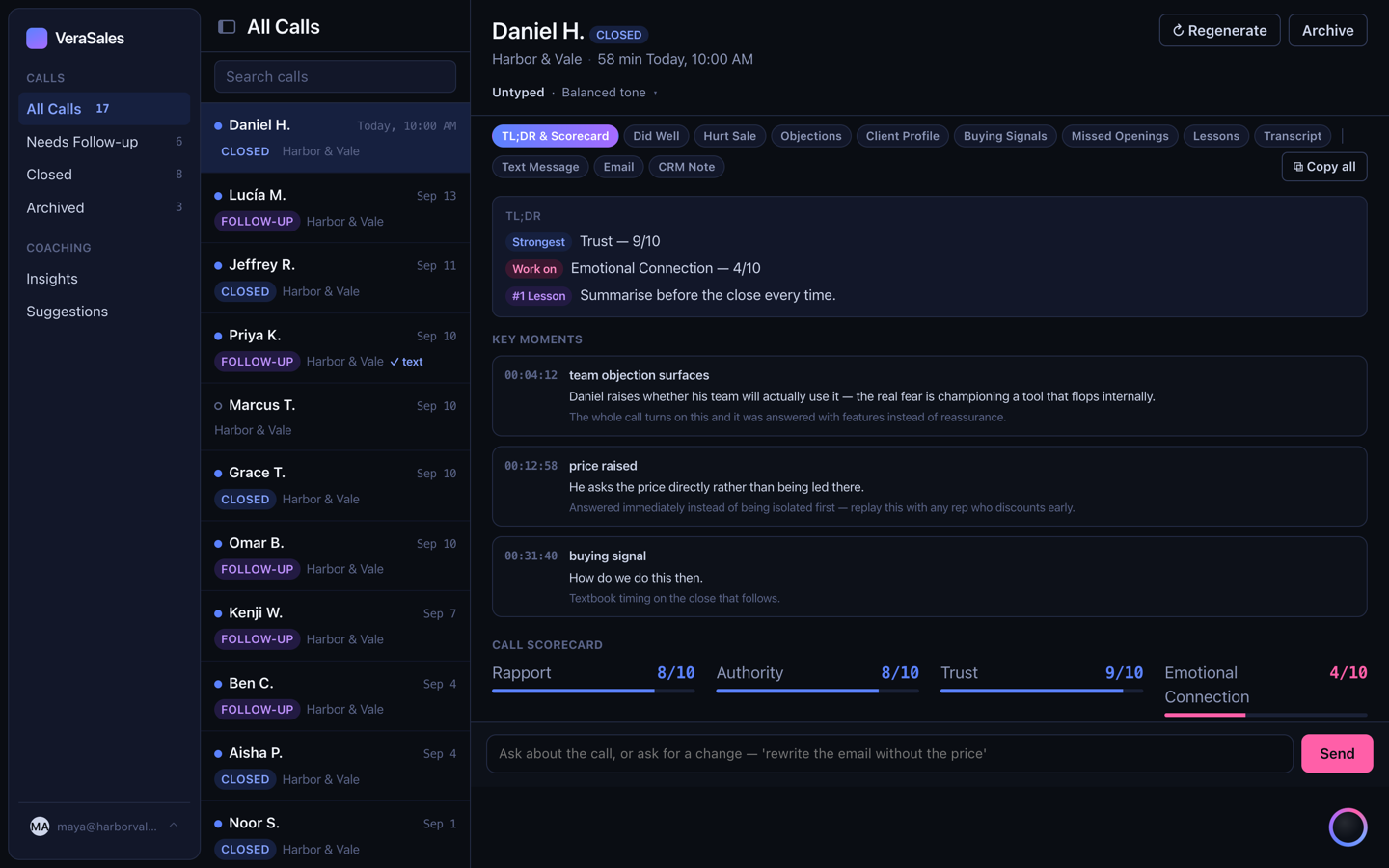
- Scored minutes after it ends, on the dimensions you choose, by call type. A discovery call is not graded like a close.
- The moment it turned, linked to the second in the recording. Click the moment, watch it, then read what the rep did next.
- The follow-up and the CRM note, written from what was actually said, in the tone that fits the call, ready to paste.
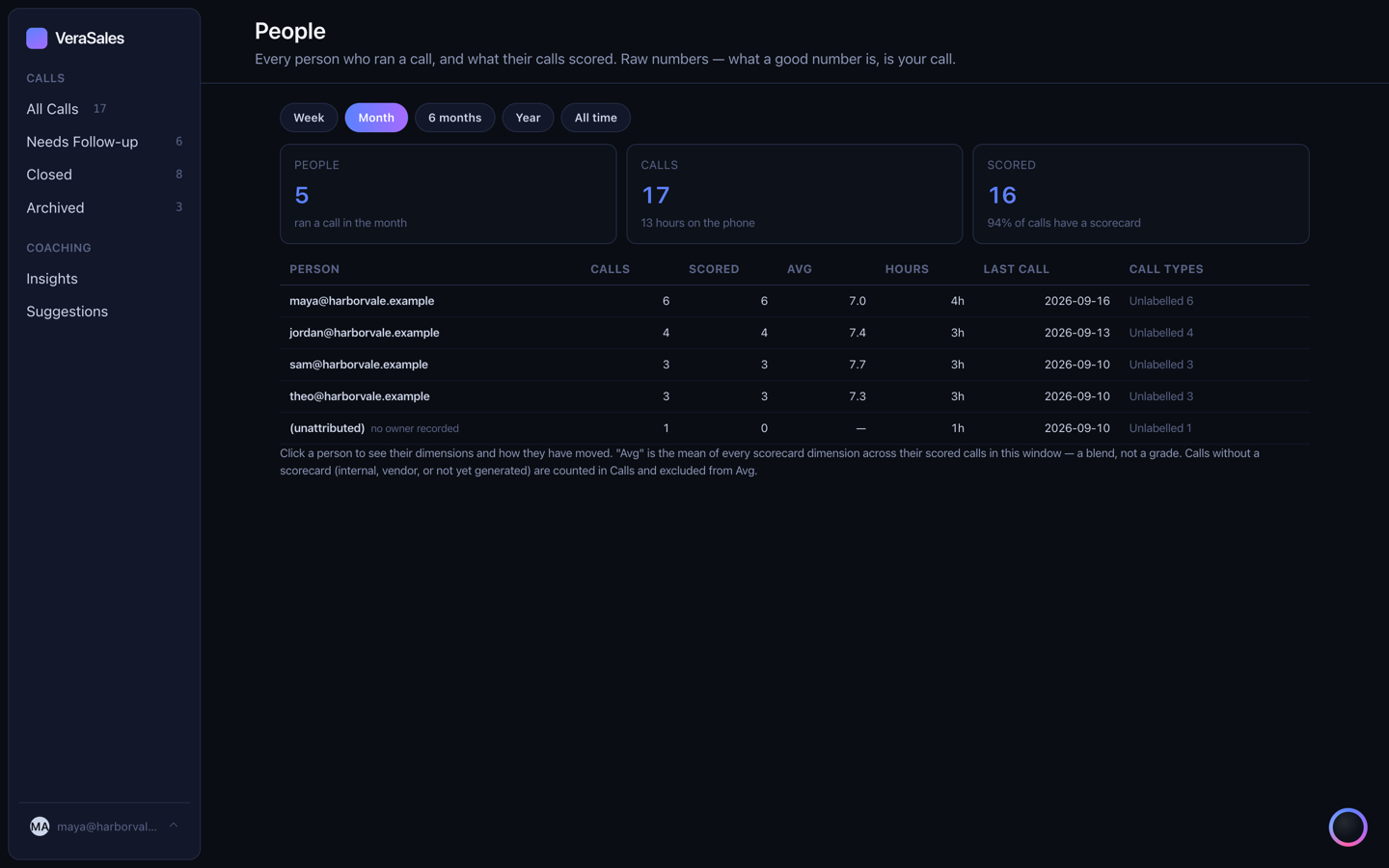
- Who is winning and who is stuck, per person, over any window. Calls, scores, hours, and how each dimension has moved week by week.
- Vera, the assistant who has read every call you can see. Ask her which three moments to bring to training this week and she links each one.
How it works
Three steps from here to your first scored week.
- Today
Request access
Two minutes. Tell us how many closers you run, what records your calls and what your CRM is. A person replies within one business day.
- 45 min
The setup call
We connect your call recorder, your own AI account and your CRM, together, on a screen share. You paste each key yourself and press Test. We never need to see them.
- Week one
Your first scored week
Calls start landing scored. Your reps open their own debriefs. You open People, and Vera, and pick who to coach next from evidence.
Your recordings stay with your recorder. The analysis runs on an AI account you own, from Anthropic or OpenAI, on an API key you control. Card details go to the payment processor's own pages. There is no annual contract holding any of it in place.
Who it is for
Built for a floor of three to thirty closers, not a call centre of three hundred.
High-ticket sales teams that already record their calls and already coach, and want the coaching to start from the moment rather than from the search for it.
You will get the most from it if
Your closers record on Fathom (or you can paste transcripts), your team runs on GoHighLevel or a CRM with notes, and someone owns training. Three closers is where the People page starts to earn its keep.
Come back when
Your calls are not recorded, or you are a solo closer. The product reads recordings; without them there is nothing to coach from. One closer will find the debriefs useful and the comparisons empty.
Friday training: somebody remembers a call from Tuesday that went sideways, cannot find the timestamp, and describes it from memory while the room nods.
Open Vera. "Which three moments should I bring to training this week?" Each one links to its second. The room watches the exact moment, then the scorecard for it, then what the rep did next.
Questions
The ones every floor asks first.
Is this monitoring my reps?
It is a coaching tool the rep opens for themselves. Their call, their score, what they said, what to have said instead, and their drafts. Managers see the same, across the team. That framing is the difference between adoption and quiet sabotage, and your reps will recognise which one they are being handed.
What records the calls?
Fathom today, connected with a key from your own workspace; new recordings import themselves every few minutes. Any other recorder works by pasting the transcript. If you record on something else and want it connected, say so on the application.
Which AI does the scoring, and who pays for it?
Any frontier model with API access, from Anthropic (Claude) or OpenAI, on an account you own. You choose the model and the effort level in Integrations. You pay the provider directly; it is typically between fifty cents and a dollar a call, and the Spend page shows you the estimate by day, week and month.
How is the scorecard decided?
Per call type, and you can edit it. A discovery call, a close and a team meeting each carry their own prompt, their own dimensions and their own outputs. The starting scorecard is a proven one; the point is that it becomes yours.
What about our CRM?
GoHighLevel connects with a private integration token from your own account. Every call comes with a CRM note written for it and ready to paste; the setter who booked the call comes across from your CRM so attribution is right on the People page.
How long until we are live?
Most teams see their first scored calls within a week of the setup call. The setup call itself is forty-five minutes, and the things that make it fast are on the application: who administers your CRM, and that every closer is recording.
What does it cost?
An activation that includes your first thirty days, then a monthly price per team with a fixed price per additional seat. We quote it on the reply to your application, because it depends on how many people you seat. There is no annual contract.
Start with two minutes.
Tell us about your floor. A person reads it and replies within one business day, and if it fits, the next step is a forty-five minute setup call.